Most creative entrepreneurs start with passion.
But if you want to build something that lasts, something that grows, you’ll need more than passion. You’ll need structure.
One of the biggest turning points in your creative business journey is when you stop being the business… and start building the business.
In this guide, you’ll learn three essential shifts that will help you separate yourself from the business financially, mentally, and operationally.
These aren’t theory. They’re moves I made when I rebuilt from scratch, after burnout, breakdowns, and bouncing back stronger.
1. Price Like You’re Not the One Doing the Work
The mistake? Most creatives price based on what feels “fair” or “doable.”
But fair isn’t scalable and doable isn’t profitable.
If you’re the one doing everything, you might charge less to “win the deal.”
But what happens when you want to grow your team?
What if you get sick? What if you want to step back?
Here’s the rule: Price like you’re hiring someone else to do the job. That includes:
- Your profit margin
- Time off
- Business expenses
- And the cost of quality execution — with or without you
👉 This is how businesses grow beyond the founder. The EARN7™ framework from our guide shows you exactly how to calculate that.
2. Pay Yourself First (Or Risk Stealing From the Business)
Too many creative entrepreneurs leave themselves out of the equation. You finish a project. The client pays. And suddenly, it all blends together:
- Rent
- Wi-Fi
- A quick bite
- That new plugin
- That overdue bill
The business is funding your life, but you’ve never actually paid yourself.
The danger here? You can’t measure what you don’t allocate. And you can’t grow a business if you’re always taking from it like a backup wallet.
Pay yourself a fixed amount. Weekly or monthly. Even if it’s small. It builds the discipline that builds a future.
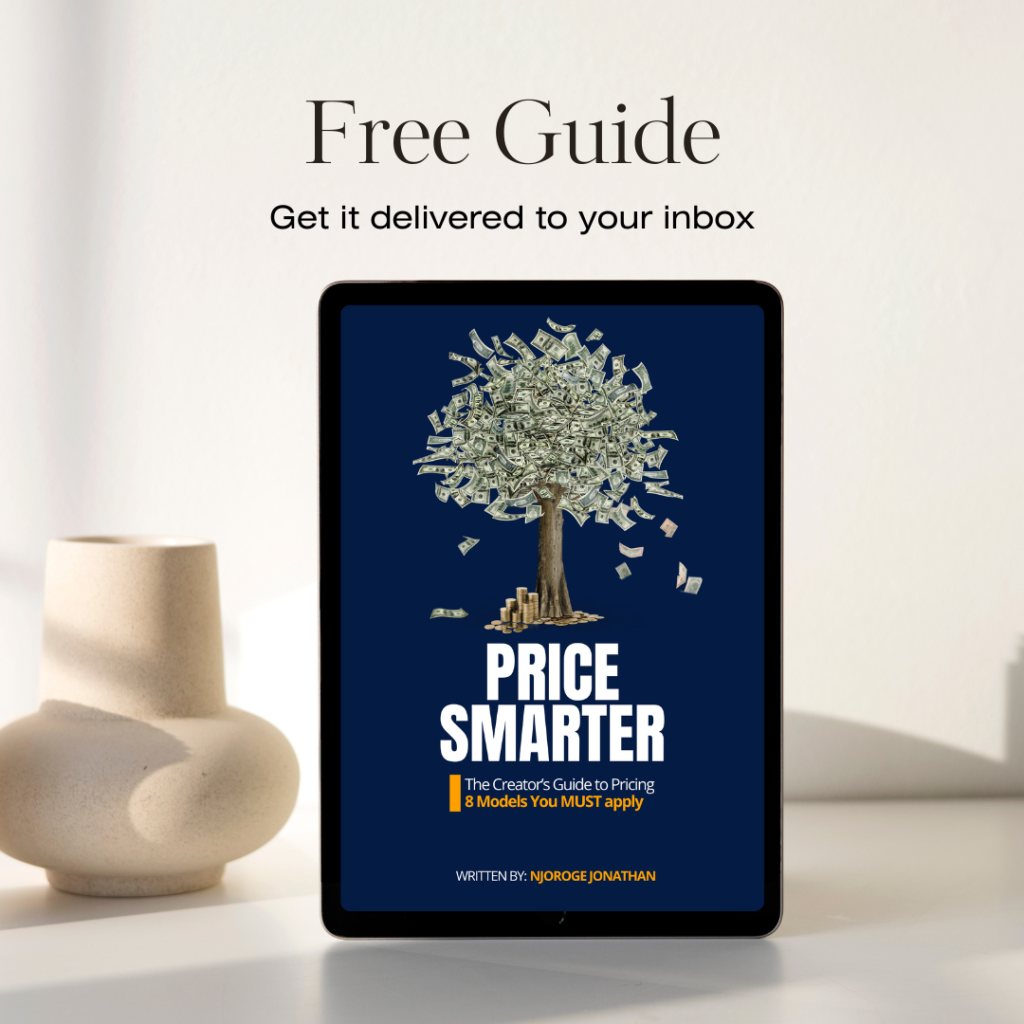
Download the FREE Price Smarter Guide to begin this journey — with 8 pricing models and frameworks to help you scale like a business, not a freelancer.
3. Separate Your Business and Personal Accounts
This one’s tactical but transformational. Having a separate bank account for your business isn’t about looking professional, it’s about thinking like a CEO. It gives you:
- Clear reporting
- Better tax tracking
- Psychological distance
- And better decision-making
Use your business account for income and expenses only. Use your personal account for lifestyle and living.
Even if it means using MPesa for personal and bank for business that small step changes how you show up. It tells your brain, “This is a business. And I’m building something real.”
The Shift from Hustler to Founder
You started as the talent. Then you became the technician. But if you want to grow — you need to become the architect. That starts with separation.
- Price for growth
- Pay yourself with dignity
- Protect your business with boundaries
Download the FREE Price Smarter Guide to begin this journey — with 8 pricing models and frameworks to help you scale like a business, not a freelancer.